AC 2.1 With reference to a people practice issue, interpret analytical data using appropriate analysis tools and methods.Table 1a. Percentage of each gender by type
Total
Calculation
(Total/260)* 100
Percentages
Male
140
(140/260)*100
53.84
Female
118
(118/260)*100
45.38
Non-binary
2
(2/260)*100
0.769
Total
260
The table above represents gender percentages. The male employees represent 53.84% of the total employee population, female 45.38% and non-binary 0.76%b. Ethnicity as a percentage per teamAs per the above, the white British employees contain the highest team percentage since they occupy all job units. This is in comparison to other minority ethnic groups such as Chinese, Black other, Asian-Bangladesh and mixed other which have low population percentage.
c. Disability percentage as an organisational whole and by teams. Organisational Whole Total Calculation (Total/260)* 100 Percentage Not Disabled 239 (239/260)*100 91.92 Disabled 21 (21/260)*100 8.07 Total 260 The diagram shows disability percentage calculations for disability percentage as a whole organisation with an employee population of 260. For instance, disabled employees represented 8.07% whereas the percentage of the non-disabled employees is 91.92%. Disability percentage as an organisational team Calculation Percentages Calculation Percentages Disabled (Total/Number per team)* 100 Disabled Not disabled (Total/Number per team)* 100 Not Disabled Business Services 0 (0/9)*100 0.00 9 (9/9)*100 100.00 Community Engagement and Partnerships 1 (1/7)*100 14.29 6 (6/7)*100 85.71 Customer Services 3 (3/13)*100 23.08 10 (10/13)*100 76.92 Directors 0 (0/5)*100 0.00 5 (5/5)*100 100.00 Facilities 0 (0/2)*100 0.00 2 (2/2)*100 100.00 Finance 2 (2/10)*100 20.00 8 (8/10)*100 80.00 Governance 0 (0/3)*100 0.00 3 (3/3)*100 100.00 Green Spaces 1 (1/12)*100 8.33 11 (11/12)*100 91.67 Housing 2 (2/18)*100 11.11 16 (16/18)*100 88.89 Income Team 1 (1/19)*100 5.26 18 (18/19)*100 94.74 IT 2 (2/9)*100 22.22 7 (7/9)*100 77.78 Lettings 1 (1/10)*100 10.00 9 (9/10)*100 90.00 Marketing 0 (0/4)*100 0.00 4 (4/4)*100 100.00 People Services 2 (2/11)*100 18.18 9 (9/11)*100 81.82 Property Team 5 (5/14)*100 35.71 9 (9/14)*100 64.29 Regeneration 0 (0/5)*100 0.00 5 (5/5)*100 100.00 Supported Housing 0 (0/11)*100 0.00 11 (11/11)*100 100.00 Tenancy Team 1 (1/11)*100 9.09 10 (10/11)*100 90.91 The above data show that the non-disabled employees have a higher employee population rate in the teams than the disabled workers. The disabled have no presence in some teams such as business service, supported housing, regeneration and marketing. However, they are limited in departments such as the tenancy team with 9.09%, lettings 10% and property team 35.71%. d. Salary difference across genders. Total number Total Salary Calculation Average Salary (Total Salary/ Total number) Non-Binary 2 $39000
management practice organisational the and within approach people development context evidence this performance strategic process framework in. of analysis professional outcomes effective to a management practice organisational the and within approach people development context. evidence this performance strategic process framework in of analysis professional outcomes effective to a management practice organisational. the and within approach people development context evidence this performance strategic process framework in of analysis professional. outcomes effective to a management practice organisational the and within approach people development context evidence this performance. strategic process framework in of analysis professional outcomes effective to a management practice organisational the and within. approach people development context evidence this performance strategic process framework in of analysis professional outcomes effective to. a management practice organisational the and within approach people development context evidence this performance strategic process framework. in of analysis professional outcomes effective to a management practice organisational the and within approach people development. context evidence this performance strategic process framework in of analysis professional outcomes effective to a management practice. organisational the and within approach people development context evidence this performance strategic process framework in of
Subscribe to Unlock
Subscribe to unlock this premium content and access our entire library of exclusive learning materials.


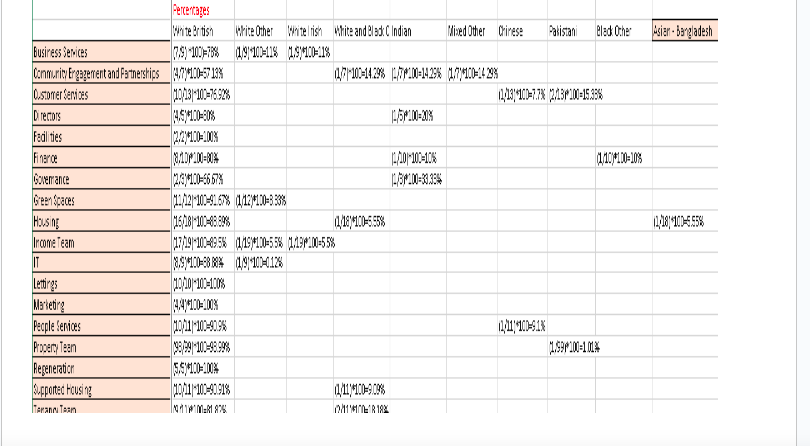 As per the above, the white British employees contain the highest team percentage since they occupy all job units. This is in comparison to other minority ethnic groups such as Chinese, Black other, Asian-Bangladesh and mixed other which have low population percentage.