

3CO04 Essentials of People Practice from CIPD Level 3 gives learners a basic understanding of important people practices in the workplace. It covers areas such as recruitment, performance management, and employee relations, helping you develop the skills to support HR operations effectively.
Table of Contents
Task One – Recruitment and Selection
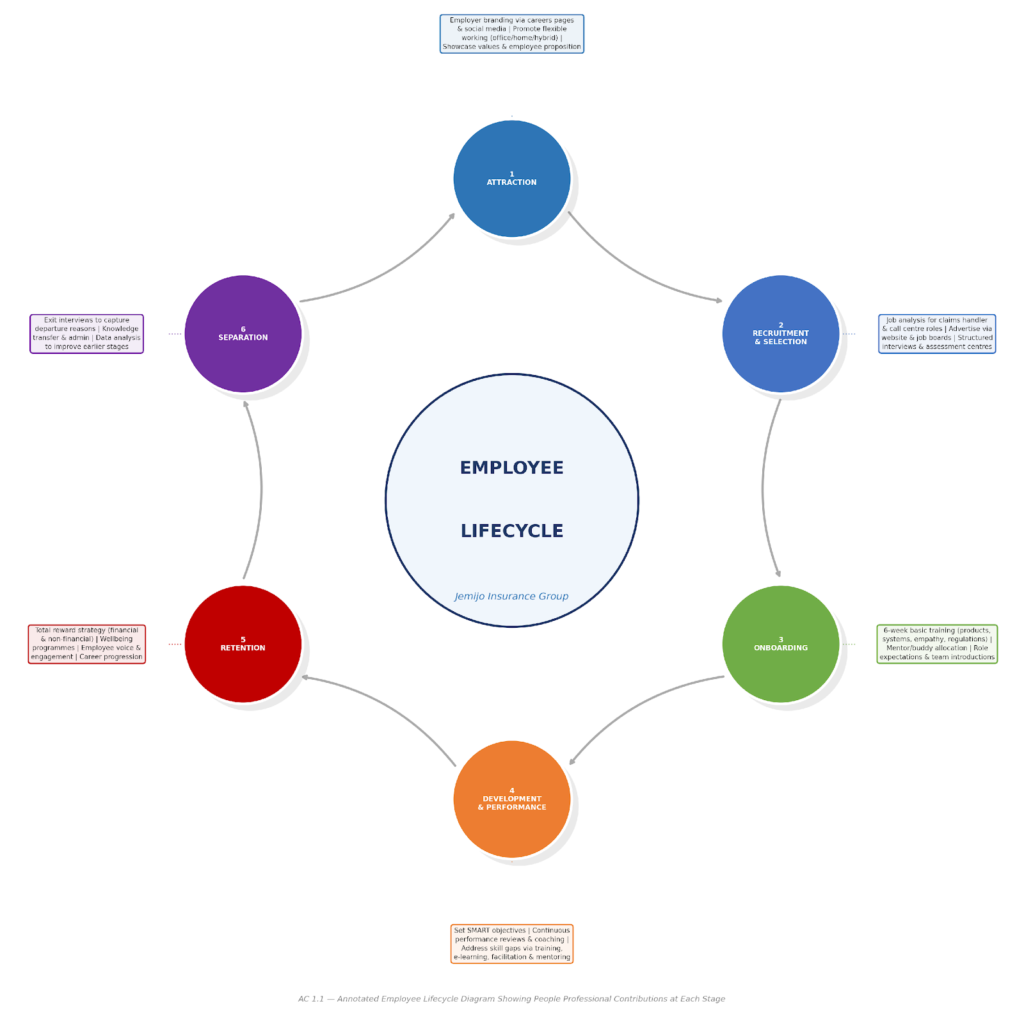
AC 1.1 Create a diagram that shows stages in the employee lifecycle. After reading all the tasks in the assessment brief, annotate each stage to explain how people professionals at Jemijo could contribute to the stages in your diagram.
Understanding the Employee Lifecycle
The employee lifecycle is a strategic framework that maps the sequential stages through which individuals progress during their relationship with an organisation, from initial awareness through to eventual departure. For a large-scale employer such as Jemijo, which manages over 2,500 employees across multiple locations and working patterns, understanding this lifecycle enables people professionals to design targeted interventions at each stage that maximise both employee experience and organisational effectiveness.
Stage 1: Attraction
At the attraction stage, Jemijo’s people professionals build the organisation’s employer brand to position Jemijo as an employer of choice within the competitive insurance sector. This involves communicating the organisation’s values, culture, and employee proposition through careers pages, social media presence, and engagement with professional networks. Given that Jemijo offers varied working arrangements including office-based, home-based, and hybrid options, promoting this flexibility serves as a significant attraction differentiator in the current labour market where candidates increasingly prioritise work-life balance (CIPD, 2024).
Stage 2: Recruitment and Selection
People professionals at Jemijo manage the end-to-end recruitment process, beginning with job analysis to define role requirements accurately, progressing through the design of inclusive advertising strategies across the company website and commercial job boards, and concluding with structured selection processes. For call centre vacancies, this involves designing selection methods that reliably assess communication skills, customer empathy, and resilience under pressure – competencies central to handling insurance queries and claims effectively.
Stage 3: Onboarding
Effective onboarding at Jemijo integrates new employees into the organisation’s culture, systems, and team dynamics. For call centre staff, this includes the six-week basic training programme covering insurance product knowledge, customer communication techniques, empathy development, and regulatory compliance. People professionals coordinate mentoring arrangements, introduce new starters to their teams, and ensure clarity regarding role expectations, performance standards, and reporting relationships.
Stage 4: Development and Performance Management
People professionals at Jemijo design and deliver ongoing learning and development opportunities that address evolving skill requirements, close competency gaps identified through performance reviews, and support career progression. Performance management activities include establishing clear objectives aligned with business targets, providing regular feedback and coaching, and conducting both continuous reviews and formal appraisals to track progress and identify development needs.
Stage 5: Retention
Retention activities at Jemijo focus on sustaining employee engagement, satisfaction, and commitment. People professionals contribute through competitive total reward strategies combining financial and non-financial elements, wellbeing initiatives addressing the particular stresses of call centre work, recognition programmes, and career development pathways. Employee voice mechanisms including surveys, forums, and one-to-one conversations enable early identification of dissatisfaction before it escalates to turnover intention.
Stage 6: Separation
When employees leave Jemijo, people professionals manage the offboarding process including conducting exit interviews that generate valuable data about departure reasons, completing administrative requirements, facilitating knowledge transfer, and maintaining positive relationships with departing employees who may become future returners or brand advocates. Analysis of exit data informs improvements at earlier lifecycle stages, creating a continuous improvement cycle.